A porcelain lamp holder at a ceiling point is a heat decision before it is a style decision. The glazed body will not track, will not yellow under a bare incandescent lamp and will not soften at temperatures that turn a thermoplastic rose brittle.
This E26 ceiling rose with a side pull chain is the classic utility fitting: two keyhole slots, a 660 W rating and a switch you operate by hand.
This guide is for buyers specifying it for restoration, farmhouse, hotel and utility projects — the ratings that matter, the switch that fails first, and what belongs in the inspection plan.
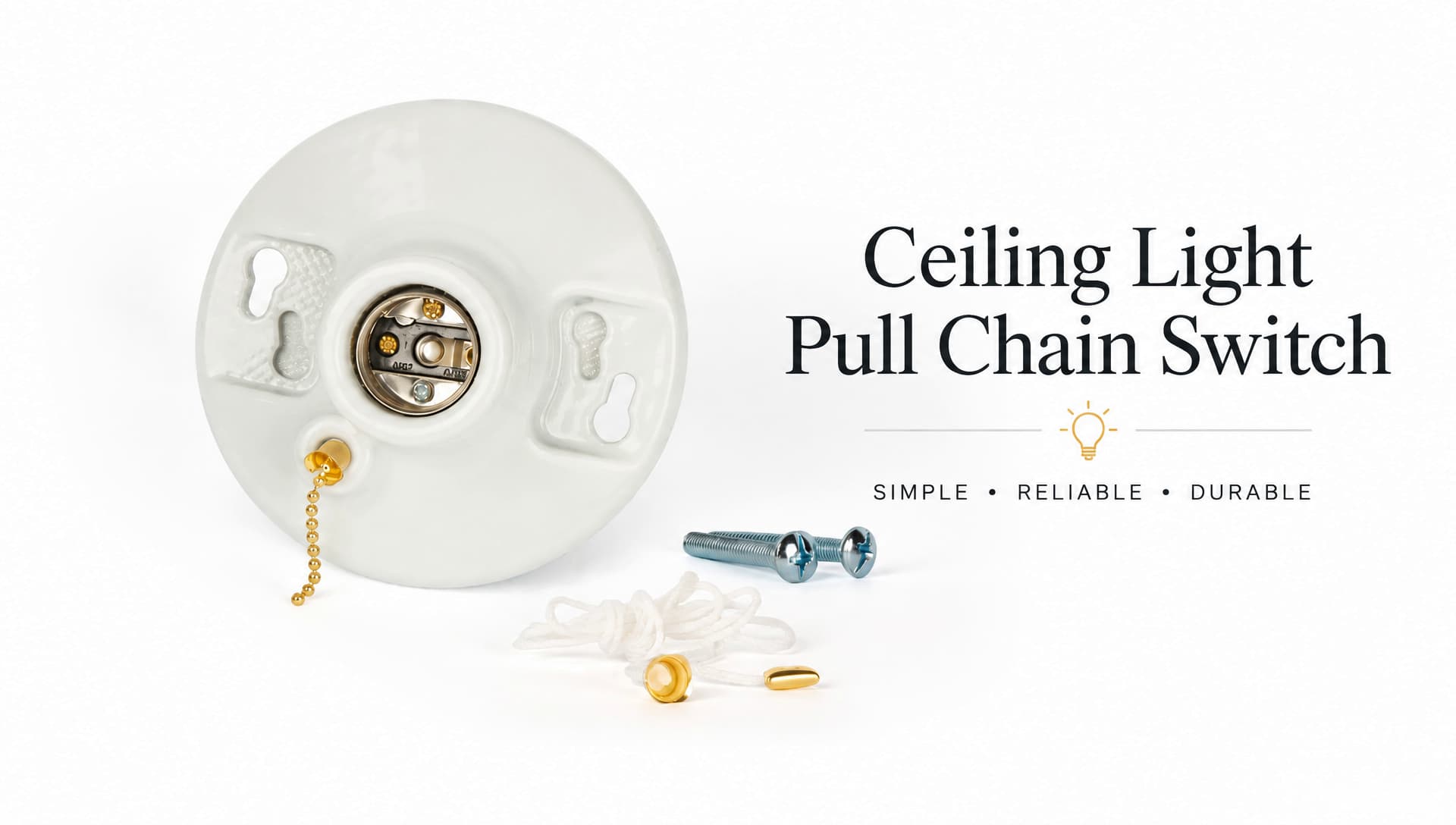
## Quick answer: where this fitting belongs
| Decision | This porcelain rose with pull chain | Choose another fitting when |
|---|---|---|
| Heat at the lamp | Glazed body, 660 W rating, no melt or tracking | A shade traps heat against a plastic canopy |
| Switching | Side pull chain, single pole, no wall switch needed | You need two-way, dimming or smart control |
| Ceiling point | Keyhole slots, direct mount on a flat ceiling | Sloped ceilings or heavy shades needing support |
| Base | E26 for North American and Japanese lamps | E27 markets in Europe and the UK |
| Look and service | White glaze, brass chain, replaceable lamp | Retail ranges that need colour matching |
Ratings and constructions above follow the current product datasheet. Confirm them against the destination standard and the latest certificate before you freeze a drawing.
## Why glazed porcelain, and where it still loses
Porcelain is fired clay under a glass glaze, so it is inorganic. It does not melt, drip or feed a flame the way a polymer can, and it does not yellow under lamp heat or UV. The glaze seals the body; a chip opens that porosity again, and moisture plus dust on a bare patch is where tracking begins.
The trade-off is mechanical. Porcelain is brittle, so it dislikes point loads, over-tightened screws and impact at the thread. A thermoplastic rose survives a dropped carton; a porcelain one may not. That makes packing an engineering decision, which is why we test the packed carton and not only the part.
## The pull chain switch is the part that fails
The chain turns a small single-pole switch inside the rose. Three things decide its life: contact material and rating, the spring that snaps the contacts apart, and the geometry of the pull. A switch that opens slowly will arc and eventually weld. A switch run near its rating on a warm ceiling ages faster than the porcelain around it.
Ask for the switch rating in volts, amps and load type, the cycle count from the test report, and the pull force. On a sample, pull the chain slowly. A healthy switch snaps; a cheap one drags and hesitates. Then pull it fifty times and measure contact resistance again.
## Mounting: keyhole slots, load and polarity
Two keyhole slots take the fixing screws, and the rose closes over them. Two failures live here. Over-tightening cracks the porcelain at the slot, and a split there is a permanent shock path. The rose also carries the lamp weight, so a heavy shade needs its own support rather than hanging from the canopy.
On wiring, the screw shell goes to neutral and the centre contact to line. That is the North American convention, and the safer one if a hand touches the shell while changing a lamp. The porcelain body is Class II and has no earth terminal; the installation sheet should say so plainly.
## 660 W on the datasheet versus the load you connect
660 W at 250 V~ is a legacy incandescent rating, about 5.5 A on a 120 V circuit. It tells you the contacts and the body survive the heat of a large incandescent lamp. It does not tell you the switch suits a 15 W LED with a driver, because the failure mode changes: the heat now comes from the driver, and the current is no longer a clean sine.
Buyers moving a range from incandescent to LED should keep the body rating and re-check the switch's electrical life on the LED load, including inrush at switch-on.
## Certification: what to ask for per market
This rose carries CE and RoHS on record. For Europe, that means a declaration plus a test file against [IEC 61184-1](https://webstore.iec.ch/) for lampholders. The E26 thread itself is a North American and Japanese pattern, so confirm the destination before a carton is printed.
For the United States and Canada, lampholders are evaluated to [UL 496](https://www.ul.com/), and a CE file is not a substitute. Ask which file covers the exact variant — white glaze, side chain, 660 W. A certificate naming a different body or switch does not travel with the part.
## Failure modes after a year on the ceiling
1. Cracked keyhole slot from an over-torqued screw.
2. Chipped glaze at the thread, then tracking across a damp patch.
3. Welded chain-switch contacts, so the lamp cannot be switched off.
4. Chain detached from the actuator, or bent out of pull alignment.
5. Terminal screw loosened by thermal cycling, reading as a flicker.
6. Lamp seized in the shell after years of heat, so the socket turns with the bulb.
7. Rose pulled off the ceiling by a heavy shade with no separate support.
## Incoming inspection and audit checklist
1. Glaze on every visible face, especially the thread and the slots.
2. Keyhole slot dimensions and screw head clearance.
3. Chain operation: fifty pulls, return, contact resistance before and after.
4. Temperature rise at 660 W, measured at the shell and the terminals.
5. Terminal torque and conductor pull-out.
6. Dielectric strength between live parts and the outer surface.
7. Drop test on the packed carton — porcelain travels badly.
8. Certificate cross-check: variant, rating and manufacturing site named.
## Ordering this rose from Aotai
Zhejiang Aotai Electronics has made wall switches, sockets, plugs, lamp holders, junction boxes and power strips since 1983, with CE, UL and RoHS compliance supporting exports to more than 30 countries. This porcelain lamp holder is quoted from 500 pcs, with glaze, plating and packaging open to OEM specification.
See the [ceramic lamp holder range](/products), how the [production lines run](/manufacturing), and what [incoming and final inspection covers](/quality). Our E26 and E27 comparison sits in [News](/news), and drawings go to [our contact page](/contact).
## FAQ
**Is porcelain better than bakelite for a ceiling rose?**
For a bare lamp on a ceiling, usually yes. Porcelain holds its shape at temperatures where phenolic bodies discolour, and it will not track once the glaze is sound. Bakelite wins where impact and cost dominate.
**Can I use an E26 ceiling rose in Europe?**
Not with E27 lamps. The thread differs by one millimetre, so an E27 lamp will not seat properly. Order the E27 variant for EU and UK markets and keep the certification file matched to that base.
**Does the pull chain work without a wall switch?**
Yes. The side chain is a single-pole switch inside the rose, so the ceiling point can be permanent live and the lamp is switched at the fitting. That suits basements, attics and older wiring.
**What is the minimum order and can it be branded?**
The reference minimum is 500 pcs. Glaze, plating, chain finish and packaging can be specified, and a change to any of them restarts the test sample, so plan that into the schedule.
---
*Written by the AOTAI technical team. Zhejiang Aotai Electronics manufactures wall switches, sockets, plugs, lamp holders, junction boxes and power strips for export markets since 1983.*