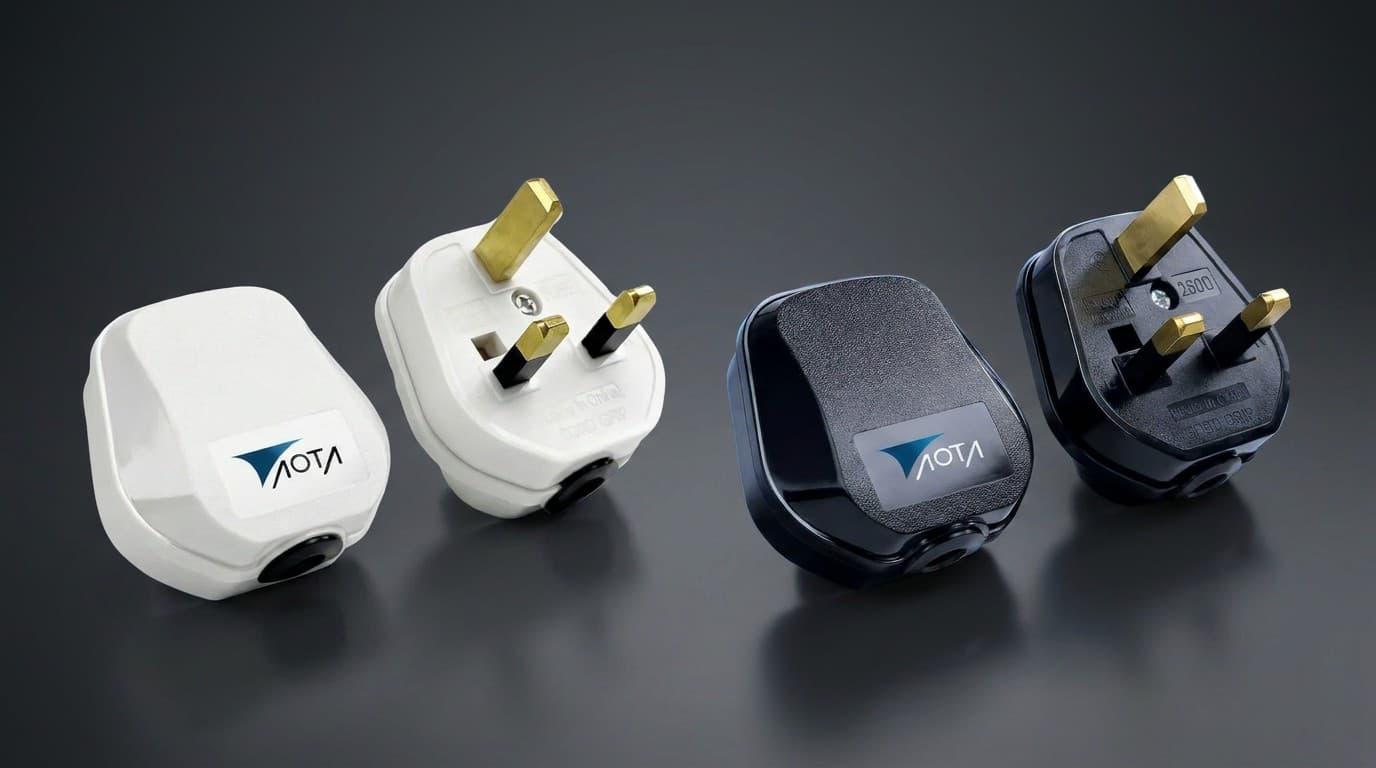
A UK 3 pin plug looks like a commodity until a shipment fails a pin gauge or a cord pull test. This rewirable plug top is rated 13 A at 250 V AC, uses screw terminals and a polycarbonate housing, and is offered in white or black for retail programmes.
Model HNBS-005EB1 is built for cord assembly, replacement and OEM work. This guide covers what a buyer should lock down before the first carton: the fuse, the pins, the terminals, the cord grip and the approval file.
## Quick answer: what this plug top is for
| Decision | This rewirable UK plug top | Choose something else when |
|---|---|---|
| Rating | 13 A, 250 V AC, three pins | You need 16 A or a continental pattern |
| Wiring | Screw terminals, field rewirable | You want a factory-moulded, non-rewirable cord set |
| Housing | PC, white or black | A phenolic body is specified for heat |
| Fuse | BS 1362 cartridge, rating set at order | The destination market has no fused plug |
| Market | UK, Ireland and BS 1363 territories | EU Schuko or North American NEMA outlets |
Ratings above follow the current product datasheet. Housing grade, fuse rating and cord range are order-specific, so confirm them in writing before tooling or printing.
## The fuse protects the cord, not the appliance
This is the point most catalogues skip. The 13 A marking is the ceiling of the plug, not the fuse you should fit. A BS 1362 cartridge fuse is sized to the flexible cord behind it: 3 A for loads up to about 700 W, 13 A above that. A 13 A fuse on a 0.5 mm² cord is the classic assembly error, because the cord can overheat long before the fuse opens.
The datasheet leaves fuse configuration to the order. Ask two questions. Which rating is fitted at the factory, and is the fuse itself approved to BS 1362 by a recognised body? An unapproved cartridge in an approved plug top still fails a market surveillance check.
## Pins: geometry, sleeves and retention
BS 1363-1 fixes the rectangular pin pattern, the spacing and the part-insulated sleeves on line and neutral. The earth pin is longer so it engages first. Three checks separate a good plug from a cheap one.
First, gauge the pins and the sleeve length against the standard, not against a sample. Second, check pin retention: a pin that moves in the body under load is a heating joint. Third, look at the brass and the plating, because thin or soft pins deform in a worn socket and then run hot.
## Screw terminals and the cord grip
Three screw terminals take the conductors. Prepare the copper cleanly, do not tin the strands with solder, and torque to the stated value. Solder creeps under pressure, so a tinned joint loosens with thermal cycling and reads as an intermittent fault months later.
The cord grip is the second mechanical gate. It must clamp the outer sheath, not the individual cores, and it must survive the pull and twist test in the standard. Confirm the cord entry range too: a grip sized for 1.0 mm² three-core will not hold a thin 0.5 mm² flex, and that mismatch is where field failures start.
## PC housing: heat, impact and colour
Polycarbonate holds its shape at the temperatures a loaded 13 A plug reaches, and it survives the drop and impact that a plug top takes in a toolbox. It is also the reason this body can be moulded in a clean white or a deep black without a paint step.
Two cautions. The datasheet says housing material is subject to model specification, so get the grade in writing rather than assuming every variant is PC. And ask for the glow-wire result on the housing, because a flame-retardant claim without a test temperature is not a specification.
## Approval: CE on record is not UK market access
This product carries CE on record. For the United Kingdom that is not the whole file. Plugs sold in the UK are governed by [the Plugs and Sockets etc. (Safety) Regulations 1994](https://www.legislation.gov.uk/uksi/1994/1768/contents/made), amended in 2026, which require plugs to be approved by a recognised body against the British Standard.
In practice that means BS 1363-1 approval from ASTA or BSI, plus a UKCA declaration for the GB market. The standard itself is published by [BSI](https://knowledge.bsigroup.com/). Ask for the certificate that names this model, the fuse rating and the cord range. A certificate for a different body or a different pin pattern does not travel with the part.
## Failure modes after a year in service
1. Wrong fuse fitted, so the cord overheats before the fuse opens.
2. Terminal screw loosened by thermal cycling, giving an intermittent supply.
3. Cord grip clamping cores instead of the sheath, then conductors pulling free.
4. Pin sleeves too short, leaving live brass accessible during insertion.
5. Soft pins deformed in a worn socket, creating a high-resistance joint.
6. Housing crazing near the cord entry after repeated flexing.
7. Fuse clip losing tension, so the cartridge runs hot and discolours.
## Incoming inspection and audit checklist
1. Pin gauge and sleeve dimensions against BS 1363-1, not against a golden sample.
2. Fuse rating, marking and approval mark on the cartridge itself.
3. Terminal torque and conductor pull-out on a wired sample.
4. Cord anchorage pull and twist test with the declared cord range.
5. Temperature rise at 13 A, measured at the pins and the fuse clip.
6. Dielectric strength between live pins and the outer surface.
7. Glow-wire and impact results for the declared housing grade.
8. Certificate cross-check: model, fuse, cord range and manufacturing site named.
## Ordering this plug top from Aotai
Zhejiang Aotai Electronics has made wall switches, sockets, plugs, lamp holders, junction boxes and power strips since 1983, with CE, UL and RoHS compliance supporting exports to more than 30 countries.
Tooling, stamping, moulding and assembly run on one site, so a housing colour, a pin finish or a retail pack is developed in-house rather than sub-contracted. This UK 3-pin plug is quoted against your drawing, cord range and annual quantity.
Browse the [plug and socket range](/products), see how the [three departments run](/manufacturing), and read what [incoming and final inspection covers](/quality). Sourcing and certification updates sit in [News](/news); send drawings and target quantities through [our contact page](/contact) for a quotation.
## FAQ
**Is a UK 3 pin plug always fused?**
A BS 1363 plug top is designed around a BS 1362 cartridge fuse, and the fuse is what protects the flexible cord. Confirm the fitted rating at order, because a 13 A plug body can be supplied with a 3 A fuse for a low-power cord.
**Can I use this plug in Ireland and other BS 1363 markets?**
Yes, the pattern is shared across several BS 1363 territories. Approval is still market-specific, so check which certificate and marking the destination accepts before printing cartons.
**Is PC better than a phenolic body here?**
For a rewirable plug top, PC gives good heat resistance with better impact strength and a cleaner moulded finish. Phenolic still wins where a specification calls for it or where cost dominates.
**What do you need from me to quote?**
The model or drawing, the destination market, the cord range, the fuse rating, the housing colour and the annual quantity. With those six items the quotation and the approval path can be confirmed together.
---
*Written by the AOTAI technical team. Zhejiang Aotai Electronics manufactures wall switches, sockets, plugs, lamp holders, junction boxes and power strips for export markets since 1983.*