A US power strip is not a Schuko strip with a different plug on the cord. It is a 15 A, 125 V relocatable power tap built to a different standard and sold into a market with its own receptacle rules. Get that wrong and your sample check passes while the retailer's compliance review fails.
This guide walks through the configuration of our six-outlet US power strip with USB-A and USB-C charging, and shows what to write on the purchase order so the build you approve is the build you receive.
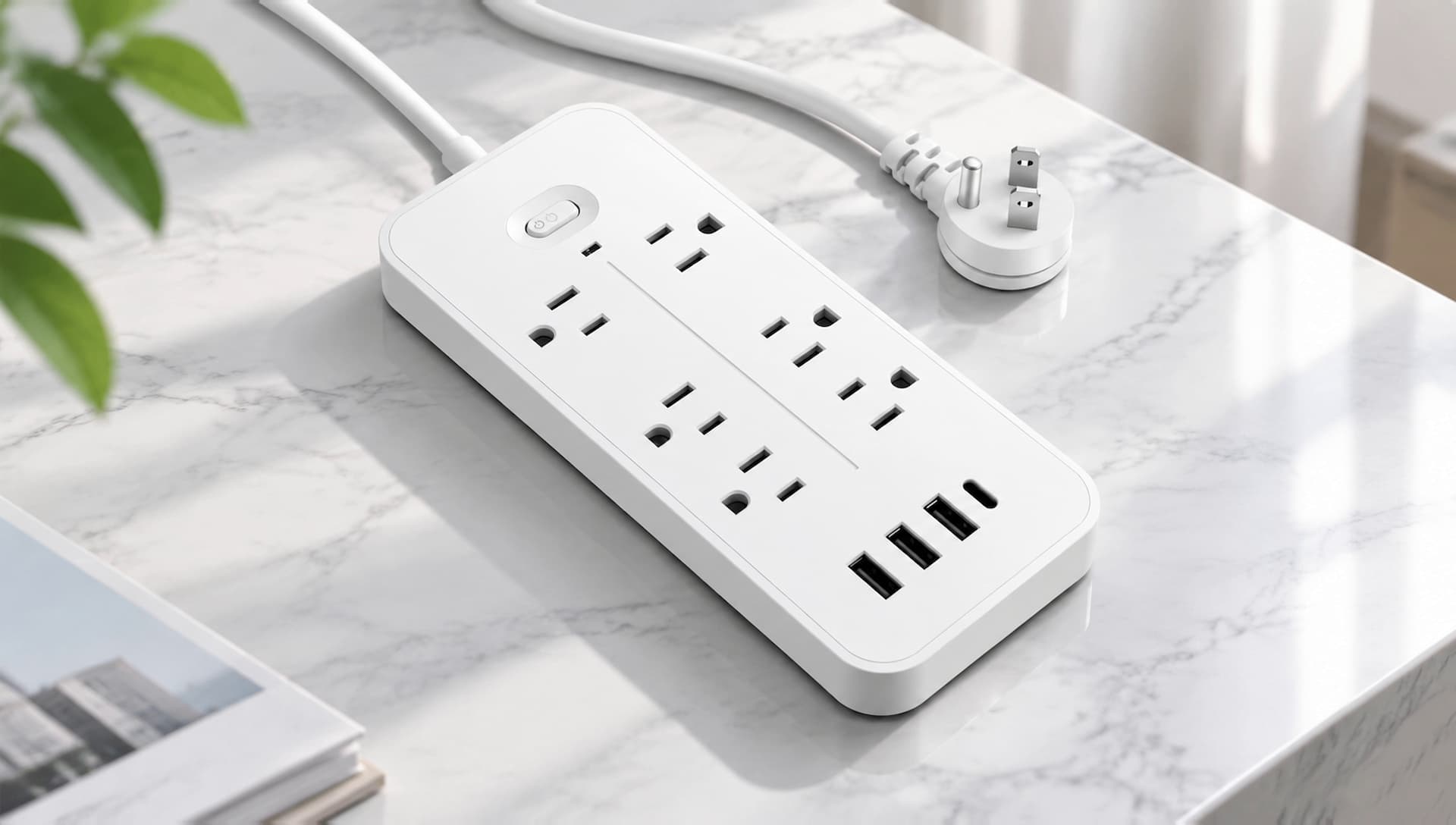
## The configuration on the table
The build this page discusses is our [six-outlet US power strip with 2 USB-A and 1 USB-C](/products/us-power-strip-6-outlets-2-usb-a-1-usb-c). As listed: six US outlets, a 15 A 125 V~ rating, surge protection, a master switch and a 1.8 m cord. Minimum order quantity is 500 pcs, and quotation depends on quantity, finish and packaging.
Those five lines are a starting point, not a specification. Each one hides a decision that changes cost, tooling and compliance. The rest of this page opens them up. If you are sourcing for Europe instead, the equivalent walkthrough for the 16 A Schuko build is in our [Schuko power strip sourcing guide](/news/schuko-power-strip-sourcing-switch-usb-surge).
## Quick spec table: what to write on the purchase order
| Spec item | What to put on the PO | What goes wrong when it stays vague |
|---|---|---|
| Outlet pattern and count | 6 × NEMA 5-15R, shuttered or non-shuttered stated | Buyer expects tamper-resistant outlets, receives open ones |
| Electrical rating | 15 A, 125 V~, 60 Hz, total load across all outlets | Strip marketed as 15 A but derated internally |
| Cord and plug | 1.8 m, conductor gauge, jacket type, NEMA 5-15P | Undersized copper runs hot at full load |
| Surge section | Joule rating, VPR, thermal disconnect, indicator | "Surge protected" with no measurable claim |
| USB output | Total watt budget plus per-port limit, all ports loaded | Single-port headline wattage that collapses when shared |
| Switch | Master rocker, rated current, illuminated or not | Switch rated below the strip it controls |
| Enclosure | Polymer grade, glow-wire and flammability class | Soft housing deforms at the terminals |
| Certification | Exact standard, file or report number, model covered | Report for a sibling model presented as cover |
Confirm limit values and test conditions with your own lab against the current standard editions before you freeze the drawing. The table is a checklist of questions, not a set of guaranteed figures.
## UL 1363 and the tamper-resistant question
In the United States, a cord-connected multi-outlet strip is evaluated as a relocatable power tap under [UL 1363](https://www. ul. com/). The attachment plug and the individual receptacles fall under UL 498.
This is a different scope from the EU approach, where the strip is assessed against the IEC/EN 60884 accessory standards. A CE-marked strip is therefore not automatically acceptable to a US buyer, and a UL-listed strip is not automatically acceptable in Europe.
Tamper resistance deserves a specific question. The [National Electrical Code](https://www. nfpa. org/) drives tamper-resistant receptacle requirements in dwelling-unit locations, and many US retailers and hospitality buyers extend that expectation to strips they stock.
It is not a universal mandate on every relocatable tap, so treat it as a customer requirement to confirm rather than an assumption. A shuttered outlet is a different mechanism and a different tool. Decide before tooling, not after the first container.
## Sizing the USB-A and USB-C budget
This is where most disappointment originates. A strip advertised on its USB-C headline wattage may only deliver that figure with the other ports empty. With three charging ports sharing one supply, the honest specification has three numbers: total budget in watts, maximum per port with all ports loaded, and the supported USB Power Delivery profiles.
Ask for those in writing, then test them. Load all ports at once and log voltage and current, because a supply that browns out under combined load will generate returns that look like "the strip stopped charging my laptop".
Also confirm standby draw with nothing plugged in, and whether USB-C supports PPS if your customer sells recent phones. Our listed build is 2 USB-A plus 1 USB-C; if your project needs a higher laptop-charging budget, that is a different power module and should be quoted as such.
## Surge protection: joules, VPR and honest limits
"Surge" on a spec sheet is not a specification. Two numbers make it real: the joule rating, which describes energy absorption, and the Voltage Protection Rating under UL 1449, which describes how much let-through voltage reaches the load. A lower VPR is better, and it is the figure your customer's engineer will actually ask about.
Then ask about failure behaviour. Metal-oxide varistors degrade with each event, so a protected strip needs a thermal disconnect that safely removes a failed MOV from the circuit, plus an indicator that tells the user protection has ended.
Without that, the strip keeps passing power while silently offering no protection at all. Request the MOV size, the VPR, the disconnect method and the indicator logic — and be sceptical of very large joule claims on a small, low-cost housing.
## Cord, plug and strain relief
The cord is the cheapest place to cut cost and the most common place to fail. For a 15 A strip, confirm the conductor gauge and jacket type rather than accepting "1.8 m cord" as a complete description. Verify the moulded NEMA 5-15P plug, the strain-relief boot at both ends, and the results of cord pull and flex testing.
Check the terminations inside as well. Busbar cross-section, rivet quality and the solder or weld joints between the busbar and the receptacle contacts all set the temperature rise at full load. A strip that measures acceptable at 8 A can still run dangerously hot at a continuous 15 A, which is exactly the condition a heater or a workshop tool creates.
## Certification: UL, CE and RoHS, and what still to verify
This build is supplied with **UL, CE and RoHS** compliance, part of a range Zhejiang Aotai Electronics has exported to more than 30 countries since 1983. For a US relocatable power tap the scope that matters is UL 1363, with the attachment plug and the individual receptacles under UL 498.
Certification in place does not remove the model-level check. Ask for evidence that names the exact catalogue number and the USB variant you are buying, and confirm the report's construction matches your samples. A listing covering a sibling model with a different power module does not cover yours.
Our [quality control scope](/quality) and [moulding and assembly lines](/manufacturing) are open to audit, and you can [send us your destination market and load schedule](/contact) for a written certification plan.
Browsing the wider [power strip and wiring range](/products) or the other [sourcing notes](/news) may help you frame the enquiry.
## FAQ
**Is a US power strip just a Schuko strip with a US plug?**
No. The rating, outlet pattern, cord gauge, surge design and certification scope all differ. A 125 V build and a 250 V build are not interchangeable, even if the housings look similar.
**Does this strip have UL certification?**
Yes. This build is supplied with UL, CE and RoHS compliance, and the relevant US scope for a relocatable power tap is UL 1363. Still request listing evidence that names your exact model and USB variant before you order.
**How many watts can the USB ports deliver together?**
That depends on the fitted power module, not the port count. Ask for the total budget and the per-port limit with all ports loaded, then verify it on samples.
**What is the minimum order quantity?**
500 pcs for this build. Custom colour, cord length, USB module or packaging can change the MOQ and the tooling cost, so confirm those together.
---
*Written by the AOTAI technical team. Zhejiang Aotai Electronics manufactures wall switches, sockets, plugs, lamp holders, junction boxes and power strips for export markets since 1983.*